
Cimbalom String Layout
The Cimbalom String Layout, Explained
Open the lid of a concert cimbalom and the first reaction is always the same: how does anyone find anything in there? A hundred and thirty-six strings, five bridges, no keys, no frets, no visible order. When I perform, people gather around afterwards and stare into the instrument the way you'd stare into an open watch.
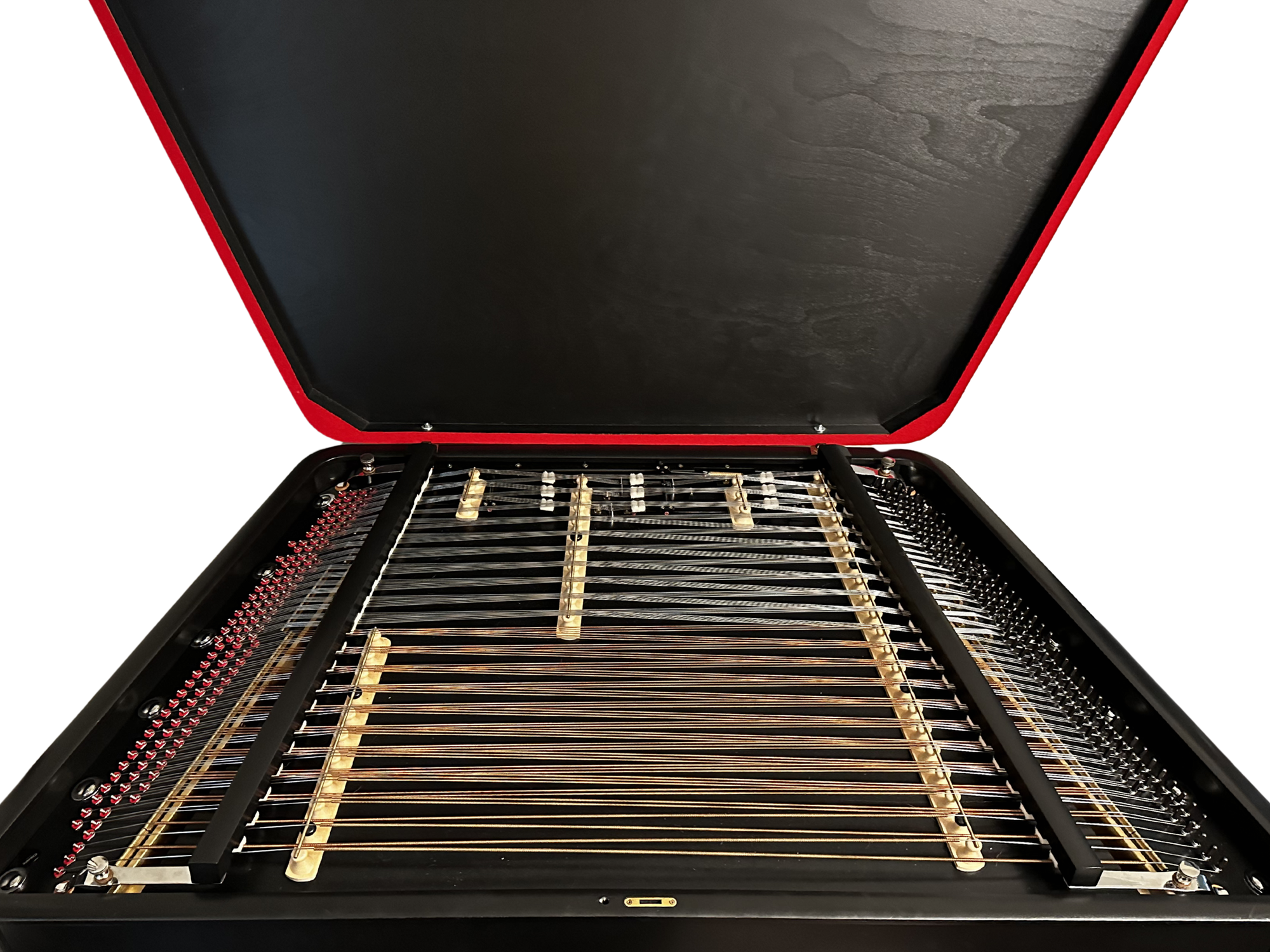
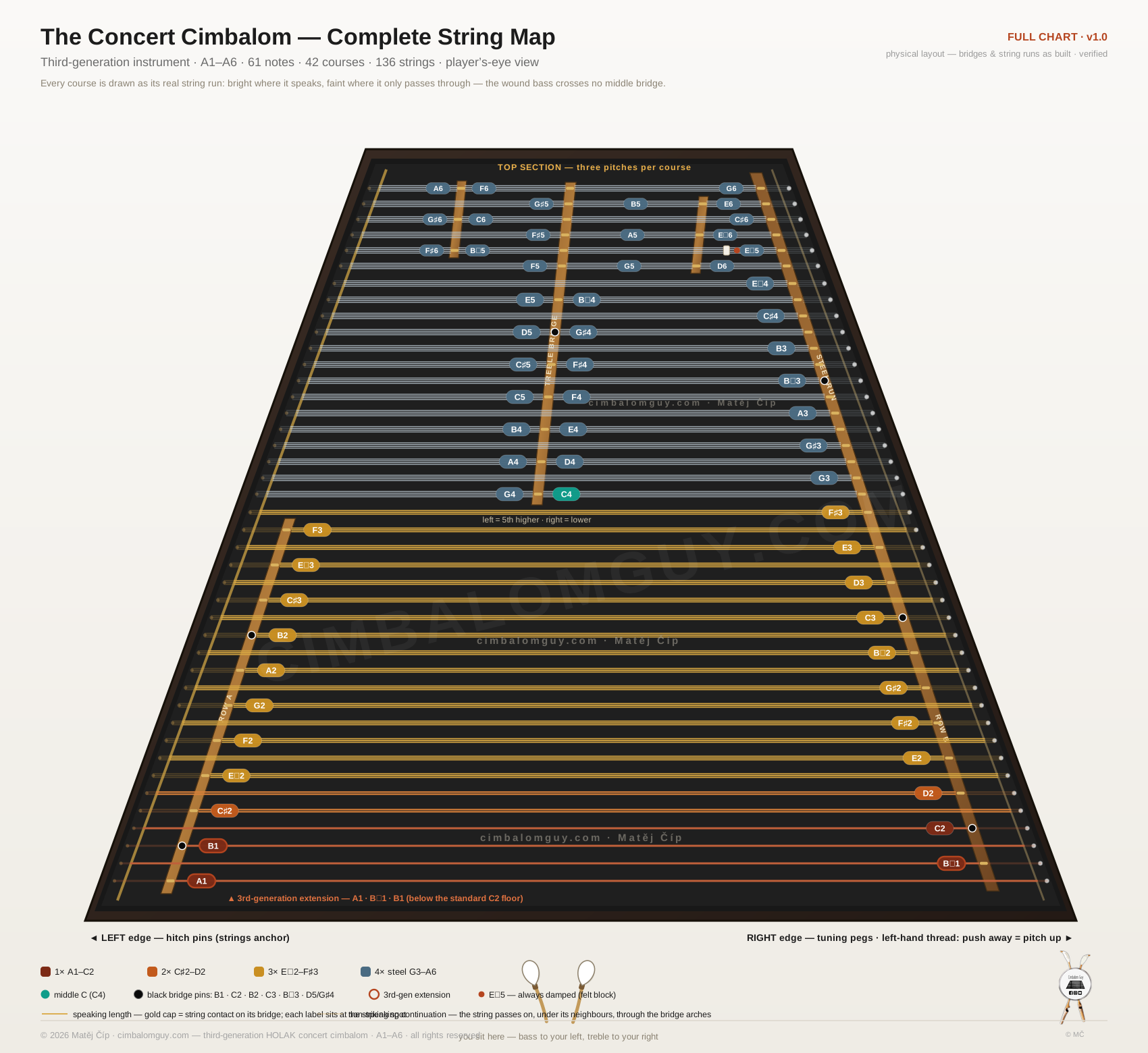
But there is an order — a beautiful one, refined over 150 years — and once you see it, you can never unsee it. The chart above is the complete string map of my own instrument, a third-generation HOLAK concert cimbalom, drawn exactly as the strings and bridges physically sit. This article is the guided tour.
First, how to read the chart
You are looking at the instrument from the player's seat: the wide edge is nearest you. On the left edge, every string anchors to a fixed hitch pin. On the right edge sit the tuning pegs. Each string is drawn as its real run across the soundboard — bright where it actually speaks, faded where it merely continues past its neighbours and through the arches of a bridge it never touches. The small gold caps mark where a string makes contact with a bridge, and each note label sits at its proper striking spot.
The numbers
Sixty-one notes, fully chromatic from A1 to A6 — five complete octaves, from 55 Hz up to 1,760 Hz. Those 61 notes are produced by 42 courses (a course is the set of strings struck together as one note), and those courses add up to 136 individual strings on my instrument. A standard concert cimbalom carries 133 strings and begins at C2; the third-generation design extends the floor three notes lower, adding A1, B♭1, and B1 — the outlined labels at the bottom of the chart. Three extra notes may not sound like much until you realize how much orchestral and contemporary repertoire lives in exactly that low register.
Fewer strings in the bass, more in the treble
Look at the colour coding and you'll see the courses thin out as they descend. The deepest notes, A1 to C2, are single thick wound strings. C♯2 and D2 get two strings each, and from E♭2 to F♯3 every note is a trio of wound strings. From G3 all the way to A6, each note is a choir of four plain steel strings.
The logic is pure physics. A low string needs mass to vibrate slowly, so it is wound with wire and one heavy string can fill a hall by itself. A high string is short, thin, and quiet, so we gang four of them together to match the volume. The result is an instrument with an even voice from bottom to top — and a tuner's afternoon of work, since every one of those 136 strings is tuned individually.
The bass: two rows in a clever braid
Here is the first stroke of genius in the layout. The bass notes are not arranged in one chromatic line. They are split into two whole-tone rows that interleave, lane by lane.
Row A, struck at the short bridge on the left, carries A1, B1, C♯2, E♭2, F2, G2, A2, B2, C♯3, E♭3, and F3. Row B, struck at the long bridge on the right, carries B♭1, C2, D2, E2, F♯2, G♯2, B♭2, C3, D3, E3, and F♯3. Each row skips by whole tones; woven together, they cover every chromatic note. Any bass note is never more than one lane from its chromatic neighbour — it's just on the other side of the instrument, which is exactly where your other hand happens to be.
The chart also shows something most diagrams get wrong: the bass field has no middle bridge at all. Each wound string is struck near its own bridge and then continues, unbroken, across the full width of the soundboard, threading past its neighbours and passing through the arches of the opposite bridge. A1's string runs on beneath B♭1's speaking length; F3's line ends quietly under F♯3's far side, and there the bass section stops.
The treble bridge: one string, two notes
Above the bass, the layout changes strategy entirely. The tall central bridge divides each steel course into two speaking lengths — strike left of the bridge for one note, right of it for another. The left side is always the higher of the two, a perfect fifth above: G4 over C4, A4 over D4, B4 over E4, C5 over F4, C♯5 over F♯4. A fifth is no accident. The bridge splits the string in a 2:3 ratio, one of the oldest and purest proportions in acoustics — the same division Pythagoras demonstrated on a monochord. The top two pairs break the pattern, sitting a tritone apart — D5 over G♯4 and E5 over B♭4 — a practical compromise that keeps the highest notes in reach before the strings enter the top section.
Between these divided courses, single-note steel courses struck at the right bridge — G3, G♯3, A3, B♭3, B3, C♯4, E♭4 — interleave lane by lane with the bridge pairs, passing untouched through the central bridge's arches. Middle C, marked in teal on the chart, sits on the right side of the lowest pair: my one concession to chart-reading convenience, because on the instrument itself nothing marks it at all.
The top section: three notes from one string
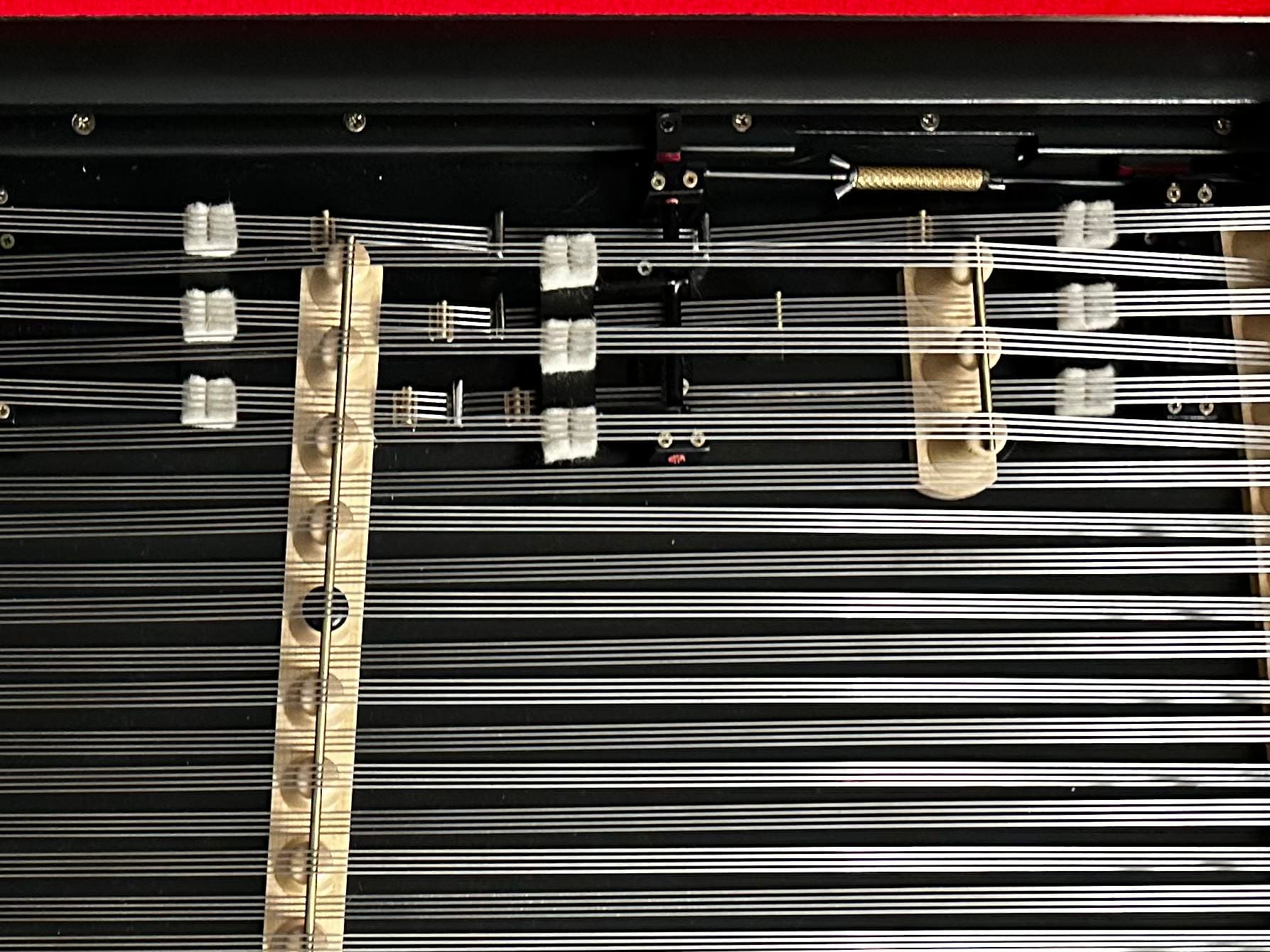
At the very top, the design squeezes even more out of each course: six courses each produce three pitches. Two small "chessmen" bridges and the upper reach of the central bridge divide each string into three speaking segments. The course that gives F5 left of the central bridge gives G5 between the bridges and D6 beyond the small right bridge; its neighbours follow the same principle with different divisions. Eighteen of the instrument's highest pitches come from just six courses.
One of them is special: E♭5 wears a permanent felt damper — the small white block on the chart. It is the traditional exception in a register that, on older instruments, rings freely; on a fully damped third-generation instrument like mine, every course from A1 to A6 answers to the pedal, and E♭5 keeps its damper as standard practice.
How a player navigates: the black pins
Pianists have the black keys. We have five black pins set into the bridges — at B1, C2, B2, C3, and B♭3 — plus one on the central bridge at the D5/G♯4 course. That's the entire visual reference system for 61 notes. Everything else is geometry in the hands: thousands of hours until the distance from C4 to any note on the instrument is not something you find but something you are. When people ask why cimbalom players watch the strings so intently, this is the answer — we are reading a map with six landmarks.
Tuning: the backwards wrench
A detail even musicians rarely know: the tuning pegs on a cimbalom have a left-hand thread, the reverse of a piano. Push the wrench away from you, counter-clockwise, and the string tightens and the pitch rises; pull it toward you and the pitch falls. Every piano technician who has ever approached my instrument with confidence has left it with humility.
check out my own composer's guide I recorded during my undergrad journey with the cimbalom across the ocean.
What this means if you're writing for cimbalom
For composers, the layout is not trivia — it is the playability of your piece. Two notes a semitone apart may sit on opposite sides of the instrument; a passage that looks simple on paper can demand leaps across the full soundboard, while a passage that looks fearsome may fall perfectly under alternating hands because of the whole-tone rows. Fast chromatic lines, tremolos on divided courses, pedal effects across a fully damped range — the idiom lives in this geometry. If you are orchestrating for cimbalom and want a professional eye on your score, get in touch — reading composers' sketches is one of my favourite parts of this work.
Frequently asked questions
How many strings does a cimbalom have?
A standard concert cimbalom has 133 strings producing 58 chromatic notes from C2 to A6. A third-generation instrument like mine carries 136 strings and 61 notes, extending the range down to A1. The strings are grouped into courses of one to four strings per note.
What is the range of the cimbalom?
The standard concert cimbalom is fully chromatic from C2 to A6 — four and a half octaves. Third-generation instruments extend this to a full five octaves, A1 to A6, roughly matching the range from the bottom of the cello to the top of the flute.
Why do some cimbalom strings play two or three notes?
Bridges divide a string into separate speaking lengths, each sounding its own pitch. The central treble bridge splits courses into two notes a fifth apart, and in the top section small bridges divide six courses into three pitches each — 18 notes from six courses.
Is the cimbalom hard to tune?
Every string is tuned individually — 136 tuning pegs on my instrument — and the pegs use a left-hand thread, the opposite direction of a piano. A full tuning takes the better part of little over an hour, and the instrument is tuned before every serious performance.
The string map above is my own work, drawn from my instrument. You are welcome to share it with credit to Matěj Číp / cimbalomguy.com — and if you'd like the print-resolution version for teaching or study.